

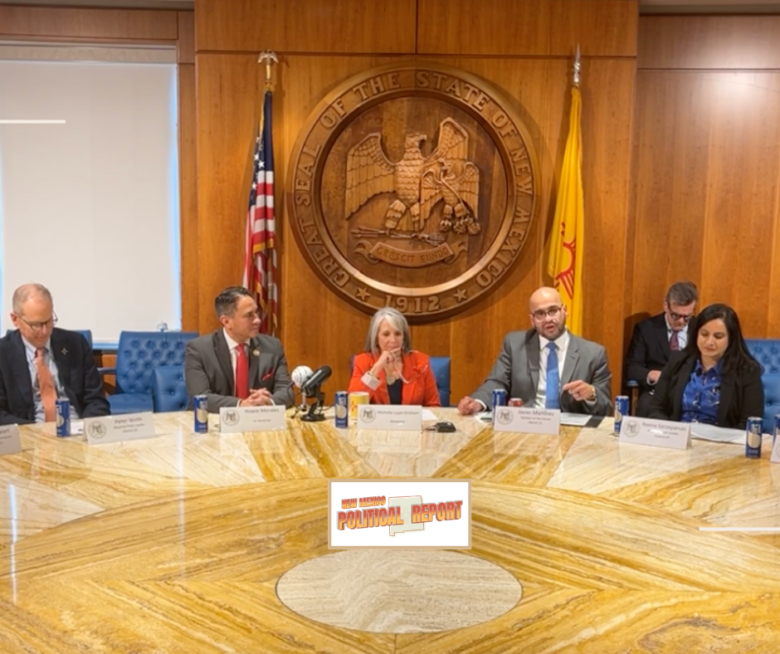
Governor Michelle Lujan Grisham’s final regular legislative session started a little rocky but delivered her many of her biggest priorities and legislators introduced dozens of bills responding to federal policy changes implemented under President Donald Trump’s return to office.
In the 30-day session, legislators sent the governor bills effectively closing private prisons detaining federal immigration prisoners, replacing federal funding gaps with state funds, and banning armed troops from local election locations, but failed to finalize new laws targeting mask use by police.
Here’s a rundown of the biggest legislative actions responding to Trump-era policies:
Immigration
HB9 requires cities and counties to end federal contracts supporting federal immigration detention activities and bans new agreements going forward. The legislation was specifically written to target private prisons holding ICE detainees in Torrance, Cibola and Otero Counties.
In addition to being among the largest employers in those areas, those prisons are also a significant source of contract and tax revenue for local governments. So, the legislature also passed SB273 setting aside $15 million over two years for cities and counties impacted.
Other immigration-related bills sent to the governor are:
- SB 40 prohibits the sharing of automated license plate reader data with companies and government agencies who use it for immigration enforcement. The bill was sponsored by Sens. Peter Wirth (Santa Fe), Cindy Nava (Bernalillo), Heather Berghmans (Albuquerque), and Micaelita Debbie O’Malley (Albuquerque) and Rep. Christine Chandler (Los Alamos). They are all Democrats.
- HB124 creates a new division in Workforce Solutions to track the economic impact of labor and business associated with immigrants and “New Americans.”
Elections
SB 264 bans armed troops at polling places and gives local officials more power to address election interference. The bill was sponsored by Democratic Sens. Katy Duhigg, a former Albuquerque city clerk, Heather Berghmans (Albuquerque), Cindy Nava (Bernalillo), Angel Charley (Acoma) and Joseph Cervantes (Las Cruces).
Medical malpractice changes
HB99 makes significant changes to New Mexico’s Medical Malpractice Act by placing caps on punitive damages that juries can award in malpractice cases. Sponsored by Rep. Christine Chandler, the bill passed with overwhelming bipartisan support — 66-3 in the House and 40-2 in the Senate — and is headed to Governor Michelle Lujan Grisham’s desk for her signature.
The bill establishes tiered limits on punitive damages based on the size of the provider or facility, $1 million for independent providers, $6 million for locally owned hospitals and $15 million for large systems. The bill also raises the evidentiary standard for punitive damages to “clear and convincing” evidence and requires a judge to review claims before they can go to trial. The caps adjust annually for inflation.
Supporters argue that capping punitive damages will lower insurance premiums and make it more financially viable for doctors to practice in New Mexico, helping to recruit and retain providers.
The governor said she will sign the bill into law as she made malpractice compensation reform one of her top priorities for the session.
“This is a giant step toward solving our doctor shortage in New Mexico, and it’s going to lead to better health outcomes for patients because they won’t have to wait so long to see a doctor,” Lujan Grisham said in a statement. “I thank the House and the Senate for heeding my call to pass medical malpractice reform and I can’t wait to sign HB 99 into law.”
Attracting more healthcare providers
Two bills designed to make New Mexico more attractive for out-of-state health care providers are already law. SB1 authorized the state to enter into agreements with other states to expedite licensing of out-of-state doctors to serve New Mexico patients. That bill was sponsored by Sens. Linda M. Trujillo (D-Santa Fe), Katy M. Duhigg (D-Albuquerque) and Nicole Tobiassen (R-Albuquerque) and Reps. Pamelya Herndon and Marian Matthews, both Democrats from Albuquerque. A similar bill for social workers, HB50, also passed but it will not take effect until enough other states pass similar legislation.
The final budget also includes new funding to expand UNM’s School of Medicine, increase pay for behavioral health and rural health care providers and expanded loan forgiveness for medical students who study in New Mexico and agree to practice here.
Crime & Justice
SB17, known as the Stop Illegal Gun Trade Act, failed on the last day of the session. The act intended to ban certain “extremely dangerous weapons” and limit the capacity of rifle magazines to 10 rounds. It would also have imposed more stringent security and record-keeping requirements for firearms dealers.
The bill was sponsored by Sens. Debbie O’Malley (D-Albuquerque), Andrea Romero (D-Santa Fe), Heather Berghmans (D-Albuquerque) and State Reps. Charlotte Little and Patricia Roybal Caballero, both Democrats of Albuquerque.
Gov. Lujan Grisham is expected to sign SB 41, which eliminates the statute of limitations on sex crimes committed against children. That means offenders can be prosecuted regardless of how long after the crimes victims come forward. The bill was sponsored by Sens. Angel Charley (D-Acoma Pueblo), Jeff Steinborn (D-Las Cruces), George Muñoz (D-Gallup) and Cindy Nava (D-Bernalillo).
HB61, which reclassifies shooting a law enforcement officer from a third-degree to a second-degree felony. In a quirk of the law, firing at and missing an officer was already a second-degree felony, carrying more severe penalties than actually hitting the officer. The bill was sponsored by Reps. Andrea Reeb (R-Clovis), William Hall II (R-Farmington), Nicole Chavez (R-Albuquerque) and Joshua Hernandez (R-Rio Rancho).
Failing to pass was HB49, increasing the maximum penalty for firearm possession by convicted felons to a maximum of 18 years. The bill was sponsored by Reps. Joy Garratt (D-Albuquerque), Heather Berghmans (D-Albuquerque), Charlotte Little (D-Albuquerque), Andrea Reeb (R-Clovis) and Debra Sariñana (D-Albuquerque).
Constitutional Amendments
The New Mexico state Legislature recently passed three proposed Constitutional Amendments for you to consider on your next ballot.
If approved by voters in Nov., SJR 1, School Election Timing, moves school board races to the general election ballot. Supporters said the shift would boost turnout, cut administrative costs for local governments and give more voters a voice in who leads their schools, according to the resolution.
Secretary of State Maggie Toulouse Oliver pushed SJR 1 as a priority. The proposal would also let school districts place bond questions on general election ballots and remove outdated constitutional language from a time when women could vote only in school elections.
The resolution was introduced by Sens. Linda M. Trujillo (Santa Fe) and Natalie Figueroa (Albuquerque), both Democrats.
HJR 1, Boards of Regents Nominating Committees, proposes a new way to pick the people who govern New Mexico’s public universities. Currently, the governor appoints these regents directly, a process critics say is often politically charged. If passed, the amendment creates independent nominating committees to vet candidates and check their qualifications before giving the governor a list of recommended names.
The resolution was introduced by Sen. Jeff Steinborn (Las Cruces) and Rep. Christine Chandler (Los Alamos), both Democrats.
HJR 5 , Legislative Compensation, would ask voters to create a formal salary for New Mexico state legislators. State lawmakers are currently part-time and only receive a per diem for expenses, making New Mexico one of the last states in the country without a legislative salary. If approved, this amendment would set up a salary tied to the state’s median household income, about $64,000 a year, meaning pay would automatically adjust based on New Mexico’s economic health. Supporters say the change aims to remove financial barriers so a more diverse group of citizens can afford to serve in the Legislature instead of just those with independent wealth.
The resolution was introduced by Sens. Cindy Nava (Bernalillo), Angel Charley (Albuquerque), Reps. Cristina Parajón (Albuquerque), Angelica Rubio (Las Cruces) and Michelle Paulene Abeyta (Abiquiu), all Democrats.
Other notable legislative actions included fully funding the first year of universal child care, a top priority of Gov. Michelle Lujan Grisham, $100 for state fair development, new judgeships in Albuquerque and Santa Fe and new money to encourage affordable housing development. The budget isn’t final, however, because the governor has significant authority to alter final appropriations through line-item vetoes of programs she does not support or to veto the entire budget altogether.
Failed to pass
A number of pieces of notable legislation had a turn in the headlines but never made it through the session including SB57 which aimed to prohibit law enforcement officers from wearing masks (Sens. Antoinette Sedillo Lopez and Micaelita Debbie O’Malley and Reps. Janelle Anyanonu and Eleanor Chávez, all Democrats from Albuquerque).
As we reported last week, a bevy of competing book ban bills to govern how libraries respond to requests for removing books made little progress in the legislature, despite months of build up and organizing by the sponsors.
State Sen. Anthony “Ant” Thornton (R- East Mountains) introduced SB49, a pilot project for a content-based library book rating system. Opposing bills including SB 65, primarily sponsored by Sen. Antoinette Sedillo Lopez (D-Albuquerque), SB 45 from Sen. Harold Pope (D-Westside Albuquerque) and HB26 from Rep. Kathleen Cates (D-Corrales, Rio Rancho) all worked to limit the ability of bans in school, college and public libraries.
None of those bills was determined to be germane in the limited budget session.
The governor has until March 11 to sign or veto legislation from the session. Legislation not acted on dies then, as well.
Most bills signed into law go into effect May 20th. The budget year begins July 1st.
Appreciate the update of important issues early enough to be discussed by the public (each other).
I’m surprised no mention in childcare?
it is to bad that new mexico is a sanctuary state, hopefully next election things change. As usual democrats remind me of imbedded terrorist screwing with the federal government or just out to fk President trump
Our governor and our legislature are a disgrace of CORRUPTION and LAWLESSNESS. They love to keep our Citizens homeless, in poverty, unemployed, uneducated, legally addicted (& mentally demotivated by weed sold at Dispensaries on every block). Our state needs a mass movement to Republicans (if they can get their act together).
FORGET COMRADE Lujan Grisham & REJECT COMRADE Deb Holland (even a more radical lunatic Leftist than the Governor). Reject all the little tin horn dictator wanna-be’s who think a “(D)” after there name and tons of cash from out-of-state will keep NEW MEXICO Stuffing their PROFIT-FILLED POCKETS from our Oil Revenue, Tax Revenue, and the sneaky tapping of the State Permanent Fund for the folks like Jeffrey Epstein, Richard Branson and Bill Richardson, etc. etc.
It was our LEGISLATURE who were bribed by the trial lawyers to allow huge malpractice payments TO DRIVE THE DOCTORS OUT OF THE STATE in the first place. It will take years before they believe you really mean to let them practice without harassment.
We need Law and Order and Honest Leadership to BUILD UP our people and our economy instead of keeping us a third-world, failed socialist state (last in nearly every measure of good among the 50 states).
Thank you for the concise summary.