
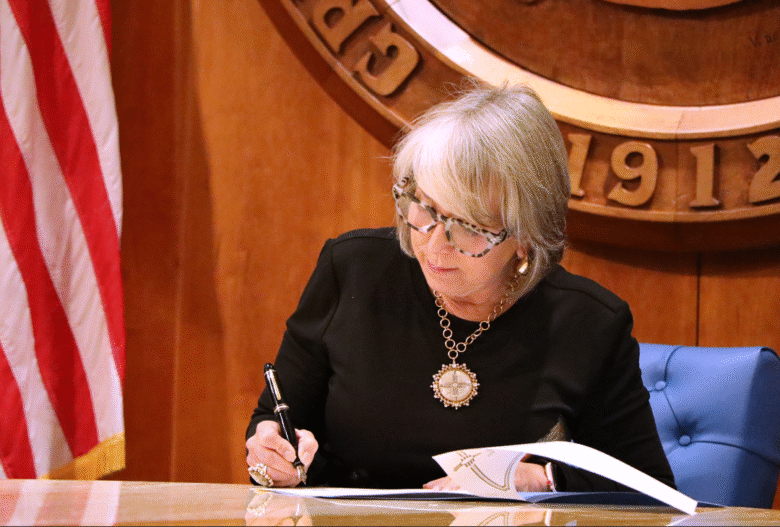
By Jesse Jones — The 2026 New Mexico legislative session is officially in the books. Gov. Michelle Lujan Grisham signed 48 dozens of (Editor’s note: this story has been updated with additional bills signed after the initial list was published on Fri. Mar. 6) bills into law from her final 30-day session, addressing issues from child care and road bonds to public safety and medical licensing. Lawmakers adjourned the session Feb. 19.
Here’s a look at what passed and when the new laws take effect.
- House Bill 1 — “Feed Bill”
Appropriates $66.6 million from the general fund for legislative session and interim expenses, including operating budgets for the Legislative Council Service, Legislative Finance Committee, Legislative Education Study Committee and the House and Senate chief clerk offices. Also covers the internship program, IT projects and redistricting expenses. Signed Jan. 27, effective immediately.
- House Bill 4 — “Health Care Affordability Fund Distributions”
Increases the share of the health insurance premium surtax directed to the Health Care Affordability Fund from 55 percent to 80 percent starting Sept. 1, 2027, and to 100 percent starting Sept. 1, 2028. A small slice — 5 percent — is redirected to the behavioral health program fund beginning in FY29. Signed March 6, effective Sept. 1, 2026.
- House Bill 7 — “Apprenticeship Assistance Act Transfers”
Keeps the annual distribution from the Workforce Development and Apprenticeship Trust Fund at $5 million per year, preventing a scheduled drop to $3 million. Funds are split between the Public Works and Apprenticeship Training Fund and Apprenticeship Assistance Act programs and signed March 4, effective July 1.
- House Bill 9 — “Immigrant Safety Act”
Bars state and local public bodies from entering into, renewing or extending agreements to detain people for federal civil immigration violations. Also prohibits agreements that authorize local officers to perform federal immigration enforcement functions and requires any existing such agreements to be terminated at the earliest allowable date. Signed Feb. 5, effective May 20.
- House Bill 34 — “School Nurse Licensure Provisions”
Updates the three-tier licensing system for school nurses, extending the same requirements to charter school nurses as public school district nurses. Removes the requirement that nurse salaries be tied to a standard 9.5-month contract and adjusts evaluation and qualification requirements for each licensure level. Signed March 6, effective July 1.
- House Bill 38 — “Wheelchair Insurance Coverage”
Requires health insurers to cover up to two complex rehabilitation technology devices — such as power wheelchairs — and up to three prosthetic or orthotic devices per affected limb every three years based on medical necessity. Prohibits insurers from denying CRT devices to people with limb absence or mobility limitations. Signed March 6, effective Jan. 1, 2027.
- House Bill 43 — “Disability & Survivor Pensions Changes”
Updates the Public Employees Retirement Act to remove, restate and clarify survivor pension provisions for public employees, consistent with current administrative practices. Signed March 3, effective May 20.
- House Bill 50 — “Social Work Licensure Interstate Compact”
Enters New Mexico into a multistate compact allowing licensed social workers from other member states to practice here more easily, including via telehealth. Requires criminal background checks for all new licensure applicants and adds knowledge of New Mexico cultures to the state’s definition of social work practice. Signed Feb. 5, effective May 20.
- House Bill 61 — “Aggravated Battery on Police Officer”
Raises the penalty for aggravated battery on a peace officer, causing injury from a third-degree to a second-degree felony, increasing the potential prison sentence from up to 3 years to up to 9. Corrects a disparity where shooting at and missing an officer carried a harsher charge than shooting and hitting one. Signed March 3, effective July 1.
- House Bill 63 — “NMFA Water Project Fund Projects”
Authorizes the New Mexico Finance Authority to make loans or grants from the water project fund for 113 projects sought by 75 public entities. The Water Trust Board will determine which projects receive funding and at what amounts. Signed March 6, effective immediately.
- House Bill 64 — “Public Project Revolving Fund Appropriations”
Appropriates $13.3 million from the public project revolving loan fund: $6.3 million to the drinking water revolving loan fund, $2 million to the local government planning fund and $5 million to the cultural affairs facilities infrastructure fund. Signed March 3, effective May 20.
- House Bill 95 — “Additional Second Judicial District Judgeship”
Creates a new family court judge position in the Second Judicial District Court and appropriates $451,400 from the general fund to cover the judge’s salary, staff and equipment. Signed March 4, effective May 20.
- House Bill 99 — “Medical Malpractice Changes”
Overhauls how medical malpractice punitive damages are handled in New Mexico, requiring plaintiffs to first establish a triable malpractice claim before pursuing punitive damages. Caps punitive damages for individual providers and locally owned hospitals, with no cap for large hospital systems. Also limits future medical care payments to actual expenses incurred rather than lump sum estimates. Signed March 6, effective May 20.
- House Bill 108 — “Watershed District Taxes and Directors”
Clarifies how watershed district board vacancies are filled when a district spans more than one soil and water conservation district, and requires those conservation districts to levy a property tax at a watershed district’s request, subject to existing rate limits. Signed March 4, effective May 20.
- House Bill 109 — “Water Project Fund Changes”
Temporarily allows the New Mexico Finance Authority to fund qualifying water projects without requiring specific legislative authorization for each one, through Dec. 31, 2029. Also revises the criteria the agency uses to prioritize which projects receive funding. Signed March 4, effective May 20.
- House Bill 111 — “Water Law Violation Maximum Penalty”
Raises the maximum civil penalty for water law violations to $3,400 per day and starts penalties accruing from the date a violator receives notice rather than after a hearing concludes. Water sold without a permit carries a penalty of double the economic benefit or $25 per barrel, whichever is greater. Signed March 4, effective May 20.
- House Bill 128 — “Firefighter Occupational Disease Disablement”
Shortens the required years of service before certain cancers are presumed to be caused by a firefighter’s employment, reducing the threshold to five years across most covered cancer types. Signed March 6, effective May 20.
- House Bill 154 — “Advanced Energy Product Definition”
Expands the list of products eligible for New Mexico’s Advanced Energy Equipment Income Tax Credit to include solar and wind components, battery parts, fusion machines, critical minerals and renewable energy inverters. The credit equals 20 percent of qualified expenditures, capped at $25 million per taxpayer. Signed March 3, applies to tax years beginning Jan. 1, 2026.
- House Bill 156 — “Repeal Special Session Vaccination Laws”
Repeals provisions from the 2025 special session requiring the Department of Health to follow national professional health associations such as the American Academy of Pediatrics, for vaccine recommendations. Signed March 6, effective May 20.
- House Bill 158 — “Plans on Use of Certain Funds”
Requires the Department of Finance and Administration and the Legislative Finance Committee to jointly develop instructions for state agencies on submitting accountability and evaluation plans for Government Results and Opportunity Fund appropriations, including performance measures and outcome assessments. Signed March 4, effective June 20.
- House Bill 165 — “Payment of Certain IRB Special Assessments”
Clarifies that when a property is leased under an industrial revenue bond arrangement, the lessee — not the property owner or local government — is responsible for paying special assessments tied to eligible improvements. Local governments bear no liability for those payments. Signed March 3, effective May 20.
- House Bill 184 — “Investment Of Conservation & Legacy Funds”
Streamlines the conservation legacy permanent fund and land of enchantment legacy fund by simplifying how distributions are calculated and preventing unused balances from becoming trapped in the fund. Starting July 1, distributions will equal 5 percent of the fund’s three-year average market value. Signed March 6, effective July 1.
- House Bill 200 — “New Homes For New Mexico Program”
Creates a first-time homebuyer loan assistance program through the Mortgage Finance Authority, offering up to $50,000 per household — or $75,000 in high-cost counties like Santa Fe, Los Alamos and Taos. Starter homes may not exceed 1,800 square feet. Signed March 6, effective May 20.
- House Bill 253 — “Public Education Changes”
Renames the Statewide Cyber Academy Act the Distance Learning Act and sets new standards for full-time distance learning programs, including instructional hours, teacher licensing and student data privacy. Prohibits districts from requiring students to enroll in distance learning and bars grade-level expansion without state certification. Signed Feb. 25, permanent provisions effective July 1.
- House Bill 255 — “Public Safety Workforce Building Program”
Creates a competitive grant program to fund recruitment, retention, training and professional development for law enforcement, firefighters, corrections officers, detention officers and public attorneys. Consolidates three existing workforce funds into one, unlocking more than $40 million administered by the Department of Finance and Administration. Signed March 3, effective July 1.
- House Bill 270 — “Contributions to Apprentice & Training Programs”
Requires employers on street, highway, bridge and road public works projects to contribute to apprentice and training programs, closing a previous exemption for those project types. Sets contributions at zero only for trade classifications where no approved apprenticeship program exists. Signed March 4, effective July 1.
- House Bill 306 — “Prohibit Certain Health Care Facility Fees”
Streamlines the conservation legacy permanent fund and land of enchantment legacy fund by simplifying how distributions are calculated and preventing unused balances from becoming trapped in the fund. Starting July 1, distributions will equal 5 percent of the fund’s three-year average market value. Signed March 6, beginning in January 2028.
- House Bill 285 — “Disabled Veteran Property Tax Changes”
Clarifies that disabled veterans must continuously occupy a property as their primary residence to qualify for the property tax exemption. When two or more disabled veterans own the same property, the highest disability percentage among them determines the exemption amount. Signed Feb. 25, effective immediately.
- House Bill 291 — “Tax Changes”
Makes technical and policy updates across the state tax code, including allowing the Taxation and Revenue Department to waive interest when granting filing extensions, letting delinquent taxpayers renew licenses through payment plans, rounding tax amounts to the nearest five cents and expanding the film production tax credit to include expenditures on tribal land. Signed March 4, effective July 1.
- Senate Bill 1 — “Interstate Medical Licensure Compact”
Creates a faster second pathway for doctors already licensed in other compact states to practice in New Mexico without redundant re-licensing. Does not replace existing state licensing. A joint interstate commission will oversee the compact and share disciplinary records across member states. Signed Feb. 5, effective May 20.
- Senate Bill 2 — “State Highway Project Bonds”
Authorizes up to $1.5 billion in transportation bonds for road and bridge projects. Raises the weight-distance tax by 35 percent and vehicle registration fees by 25 percent to help repay the debt. Adds a new fee for electric and plug-in hybrid vehicles starting Jan. 1, 2027. Signed Feb. 5, fees effective July 1.
- Senate Bill 3 — “Commitment Procedure Changes & Definitions”
- Senate Bill 19 — “School Finance Unit Value Reset”
Authorizes the Public Education Department to adjust the fiscal year 2026 school funding unit value on Feb. 27, redistributing state equalization guarantee dollars to all public schools. Includes a temporary provision to protect large districts from steep enrollment-based funding drops. Signed Jan. 31, effective immediately.
- Senate Bill 20 — “Prior Authorization & Prescription Drugs”
Refines the legal definitions of “harm to self” and “harm to others” used to determine when someone in a mental health crisis can receive involuntary treatment. Requires that a lack of decisional capacity be caused by a mental disorder and that determinations be made by a qualified mental health professional. Signed March 6, effective May 20.
- Senate Bill 21 — “Medicare Supplement Open Enrollment”
Requires Medigap insurers to offer a 60-day open enrollment window starting on the first day of a policyholder’s birthday month. During that window, policyholders 65 and older may switch to an equal or lesser plan without medical underwriting or health-based premium increases. Signed March 3, effective Jan. 1, 2027.
- Senate Bill 20 — “Prior Authorization & Prescription Drugs”
Prohibits prior authorization requirements for serious mental illness medications and chronic maintenance drugs for three years after initial approval. Requires insurers and pharmacy benefit managers to approve standard prior authorization requests within three business days — and within 24 hours for emergencies. Signed March 6, effective Jan. 1, 2027.
- Senate Bill 30 — “Reporting Of Induced Abortions”
Repeals the state requirement that all abortions performed in New Mexico be reported within five days to the state registrar. Signed March 6, effective May 20.
- Senate Bill 38 — “Fees On Registered Pet Food”
Repeals the scheduled July 1, 2026, sunset of the statewide spay and neuter program fee, keeping the program funded indefinitely. Most revenue goes to the statewide spay and neuter subaccount of the animal care and facility fund. Signed March 6, effective May 20.
- Senate Bill 40 — “Driver Privacy and Safety Act”
Establishes rules for automated license plate readers, prohibiting agencies from sharing that data if there is a reasonable belief it will be used for immigration enforcement, to target protected health care activity or to identify people based on constitutionally protected activities. Requires annual public reporting on reader use. Signed March 4, effective July 1.
- Senate Bill 41 — “Statute of Limitations for Certain Sex Crimes”
Eliminates the statute of limitations for serious sex crimes, including second-degree criminal sexual contact of a minor and second-degree criminal sexual penetration. Victims can bring charges at any time, regardless of when the crime occurred. Signed March 4, effective May 20.
- Senate Bill 43 — “Parole Requirement Changes”
Requires the Adult Parole Board to treat 30 years of incarceration as the retributive portion of a life sentence, after which parole decisions must focus on risk and readiness for release. Requires the board to hear from victims or their families before granting parole. Signed March 4, effective May 20.
- Senate Bill 48 — “State Fairgrounds District Bonds”
Authorizes the State Fairgrounds District to issue up to $92 million in revenue bonds to fund the redevelopment of the New Mexico State Fairgrounds in Albuquerque. Bonds are repaid through gross receipts and gaming tax distributions from economic activity within the district. Signed March 6, effective May 20.
- Senate Bill 58 — “Extend Property Tax Exemption Period”
Doubles the property tax exemption period for properties in metropolitan redevelopment areas from seven to fourteen years for properties acquired by a municipality on or after Jan. 1, 1986. Applies to leases executed on or after the bill’s effective date. Signed March 4, effective May 20.
- Senate Bill 101 — “Health Care Delivery & Access Act Repeal”
Removes the July 1, 2030, sunset date from the Health Care Delivery and Access Act, making the law permanent. Signed March 6, effective May 20.
- Senate Bill 104 — “Removal of Wildlife Commission Members”
Adds a formal removal process for state Wildlife Commission members, allowing the governor to hold proceedings with notice and the opportunity to be heard. Grants the New Mexico Supreme Court exclusive jurisdiction over removal proceedings. Became law without the governor’s signature, became effective Jan. 1.
- Senate Bill 111 — “Motor Vehicle Code ‘Personal Info’”
Expands the Motor Vehicle Code’s definition of personal information to include sex, gender identity, immigration status and national origin, making those details confidential and restricting their disclosure by the Motor Vehicle Division. Signed March 3, effective May 20.
- Senate Bill 132 — “DoIT Software Replacement Plan & Funding”
Allows the Department of Information Technology to use its equipment replacement revolving fund for software purchases, in addition to the hardware and capital equipment it currently covers. Signed March 3, effective May 20.
- Senate Bill 143 — “Update Certain Agricultural Fees”
Raises the commercial feed regulatory fee from 15 cents per ton to 25 cents per ton and allows New Mexico State University’s board of regents to increase it further up to the rate of inflation through fiscal year 2031. Other proposed agriculture fee increases were stripped before passage. Signed March 3, effective May 20.
- Senate Bill 152 — “Low-Income Telecomm. Assistance Program”
Creates a new low-income telecommunications assistance program funded by the state rural universal service fund, replacing a narrower telephone-only assistance program. Eligible households include those receiving need-based state assistance or meeting federal Lifeline criteria. Funding is capped at $10 million in the first year and $45 million annually after that. Signed March 6, effective July 1.
The governor has until March 11 to act on the remaining bills from the session, except for joint resolutions and memorials. If she does not sign them by that date, the measures will automatically die in what’s known as a pocket veto.
Lujan Grisham is expected to sign several education bills at the Roundhouse on Monday, March 9.
The measures include Senate Bill 37, the “High Quality Literacy Instruction Act,” Senate Bill 29, “Math Requirements for Teaching License,” Senate Bill 64, “Create Office of Special Education,” and House Bill 47, “School Employee Insurance Programs.”
On Tuesday, March 10, the governor will sign Senate Bill 241, “Child Care Assistance Program Act,” and Senate Bill 96, “Regulated Child Care Zoning Requirements.”
Editor’s note: This post is updated regularly with new bills as the governor takes action. This additional list updates bills signed over the weekend between Mar. 6 and Mar 9.
Update: More Bills signed
- House Bill 4 — “Health Care Affordability Fund Distributions”
Increases the share of the health insurance premium surtax directed to the Health Care Affordability Fund from 55% to 80% starting Sept. 1, 2027, and to 100% starting Sept. 1, 2028. A small slice — 5% — is redirected to the behavioral health program fund in FY29. Signed March 6, effective Sept. 1, 2026.
- House Bill 34 — “School Nurse Licensure Provisions”
Updates the three-tier licensing system for school nurses, extending the same requirements to charter school nurses as public school district nurses. Removes the requirement that nurse salaries be tied to a standard 9.5-month contract and adjusts evaluation and qualification requirements across all three licensure levels. Signed March 6, effective July 1.
- House Bill 38 — “Wheelchair Insurance Coverage”
Requires health insurers to cover up to two complex rehabilitation technology devices — such as power wheelchairs — and up to three prosthetic or orthotic devices per affected limb every three years based on medical necessity. Prohibits insurers from denying CRT devices to people with limb absence or mobility limitations. Signed March 6, effective Jan. 1, 2027.
- House Bill 63 — “NMFA Water Project Fund Projects”
Authorizes the New Mexico Finance Authority to make loans or grants from the water project fund for 113 projects sought by 75 public entities. The Water Trust Board will determine which projects receive funding and at what amounts. Signed March 6, effective immediately.
- House Bill 128 — “Firefighter Occupational Disease Disablement”
Shortens the required years of service before certain cancers are presumed to be caused by a firefighter’s employment, reducing the threshold to five years across most covered cancer types. Signed March 6, effective May 20.
- House Bill 156 — “Repeal Special Session Vaccination Laws”
Repeals the 2025 special session provisions that required the Department of Health to follow national professional health associations, such as the American Academy of Pediatrics, for vaccine recommendations. Signed March 6, effective May 20.
- House Bill 184 — “Investment Of Conservation & Legacy Funds”
Streamlines the conservation legacy permanent fund and land of enchantment legacy fund by simplifying how distributions are calculated and preventing unused balances from getting trapped in the fund. Distributions will equal 5% of the fund’s three-year average market value. Signed March 6, effective July 1.
- House Bill 200 — “New Homes For New Mexico Program”
Creates a first-time homebuyer loan assistance program through the Mortgage Finance Authority, offering up to $50,000 per household — or $75,000 in high-cost counties like Santa Fe, Los Alamos and Taos. Applicants must earn below 120% of the area median income. Starter homes may not exceed 1,800 square feet. Signed March 6, effective May 20.
- House Bill 306 — “Prohibit Certain Health Care Facility Fees”
Limits when hospitals can charge patients facility fees for preventive care, vaccinations and telehealth services. Requires upfront fee disclosure at scheduling and at the point of service, and prohibits hospitals from penalizing patients who cancel because of an unaffordable fee. Does not apply to rural hospitals. Signed March 6, facility fee restrictions effective Jan. 1, 2027.
- Senate Bill 3 — “Commitment Procedure Changes & Definitions”
Refines the legal definitions of “harm to self” and “harm to others” used to determine when someone in a mental health crisis can receive involuntary treatment. Requires that a lack of decisional capacity be caused by a mental disorder and that a qualified mental health professional make that determination. Signed March 6, effective May 20.
- Senate Bill 20 — “Prior Authorization & Prescription Drugs”
Prohibits prior authorization requirements for serious mental illness medications and chronic maintenance drugs for three years after initial approval. Requires insurers and pharmacy benefit managers to approve standard requests within three business days and emergency requests within 24 hours. Signed March 6, effective Jan. 1, 2027.
- Senate Bill 30 — “Reporting Of Induced Abortions”
Repeals the state requirement that all abortions performed in New Mexico be reported within five days to the state registrar. Patient names were already protected under the old law, but the reporting requirement itself is now eliminated. Signed March 6, effective May 20.
- Senate Bill 38 — “Fees On Registered Pet Food”
Keeps the statewide spay and neuter program fee alive. The fee was set to automatically expire July 1, 2026, meaning the program would have ended without legislative action. This bill removes that expiration, keeping the program funded indefinitely. Most revenue goes to the statewide spay and neuter fund. Signed March 6, effective May 20.
- Senate Bill 48 — “State Fairgrounds District Bonds”
Authorizes the State Fairgrounds District to issue up to $92 million in revenue bonds to fund the redevelopment of the New Mexico State Fairgrounds in Albuquerque. Bonds are repaid through gross receipts and gaming tax distributions from economic activity within the district. Signed March 6, effective May 20.
- Senate Bill 101 — “Health Care Delivery & Access Act Repeal”
Makes the Health Care Delivery and Access Act permanent. The law was set to automatically expire in 2030, meaning lawmakers would have had to renew it or let it die. This bill removes that expiration. Signed March 6, effective May 20.
- Senate Bill 152 — “Low-Income Telecomm. Assistance Program”
Creates a new low-income telecommunications assistance program funded through the state rural universal service fund, replacing a narrower telephone-only program. Eligible households include those receiving need-based state assistance or meeting federal Lifeline criteria. Funding is capped at $10 million in the first year and $45 million annually after that. Signed March 6, effective July 1.