

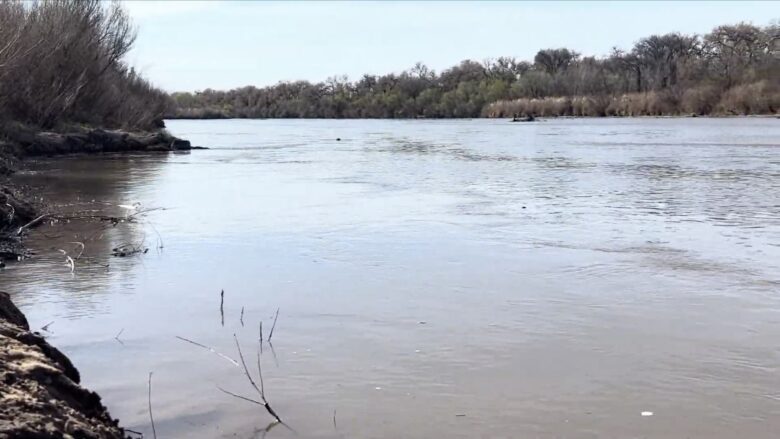
By Danielle Prokop, Source New Mexico — Snow drought across the west and record-breaking hot temperatures this winter threaten the majority of New Mexico’s rivers, according to Andrew Mangham, a senior hydrologist for the National Weather Service in Albuquerque.

This story is republished from Source NM, a part of States Newsroom, the nation’s largest state-focused nonprofit news organization.
It is republished here as a part of our commitment to bring readers the best in independent journalism, even if we don’t write it.
In an interview with Source NM on Friday, Mangham characterized the state as having an “historic low snowpack,” which he said will likely mean less water for crops, city water supplies and ecosystems, and a greater reliance on groundwater.
“Taken as a whole statewide average, this is the lowest we have ever seen and that’s not expected to turn around,” Mangham said. “For water supply, this is — for lack of a better word — a disaster.”
The state also has less reservoir space for holding snowmelt and releasing it over time into rivers than it did in previous low snowpack years because the El Vado dam, which holds storage for a significant portion of Albuquerque irrigators, remains under construction, said Carolyn Donnelly, a water manager with the U.S. Bureau of Reclamation office in Albuquerque.
The state’s remaining reservoirs “have almost no storage” for the Middle Rio Grande Valley, she said. With little water banked to supplement the Rio Grande, the state’s largest river may again dry through Albuquerque, a once-rare occurrence that has now happened twice in the past three years.
“Water in upstream reservoirs really masked the effects of the low snowpack, especially for people in Albuquerque,” Donnelly said in a phone call with Source NM. “People may be surprised to see how dry it could be this year if we don’t see good monsoon rains, they could certainly see more dry riverbeds than last year.”
Low snowpack and little water in storage leaves area farmers with “a lot of uncertainty” about which crops to plant, said Jason Casuga, the chief engineer for the Middle Rio Grande Conservancy District, which is the state’s largest irrigation district.
Casuga warned that the irrigation season, which is the period from March until September for delivering river water to farmers, could provide very little water until the monsoon rains arrive in June. He urged “flexibility” in the coming months.
“We’re willing to try new things and we’re going to have to do some new things. We can’t keep doing what we did when we had a ton of water — that’s not going to work,” he said. “We’re going to have to be willing to change our processes and be flexible, to tighten up when water’s tight.
As for recreation, so far only one of the state’s ski resorts, Santa Fe, is closing early for the season, while others such as Angel Fire, Taos and Sipapu plan to stay open through March 22, Ski New Mexico Executive Director Christy Germscheid told Source NM.
“People, looking at the conditions and the snowfall totals might have decided to opt for the beach this spring break,” Germscheid said.
The industry will have the total numbers of skiers and snowboarders in April, she said, but projections range from a 10% dip to as much as 20% fewer people than last year.
“Ultimately, it’s a rough year, there’s no sugar-coating it,” Germscheid said.
Share this story and start a conversation
Source New Mexico is part of States Newsroom, a nonprofit news network supported by grants and a coalition of donors as a 501c(3) public charity. Source New Mexico maintains editorial independence. Contact Editor Julia Goldberg for questions: info@sourcenm.com.