
Albuquerque — Martin Heinrich spent Friday morning gathered around a conference table in Downtown Albuquerque’s WESST economic development center to hear firsthand from New Mexicans how rising costs were making it harder for everyone from students to small business owners get by.
From his post as the ranking member, or top Democrat, on the U.S. Senate’s key committee on energy policy, New Mexico’s senior U.S. senator understands these issues better than most.
Those costs, he said, like gas price hikes nearly doubling the per-mile operating costs for local food trucks in the South Valley or tariffs on coconut oil central to a woman-owned soap manufacturing startup in Downtown, were the predictable impacts of ill-considered federal policies of the Trump administration.
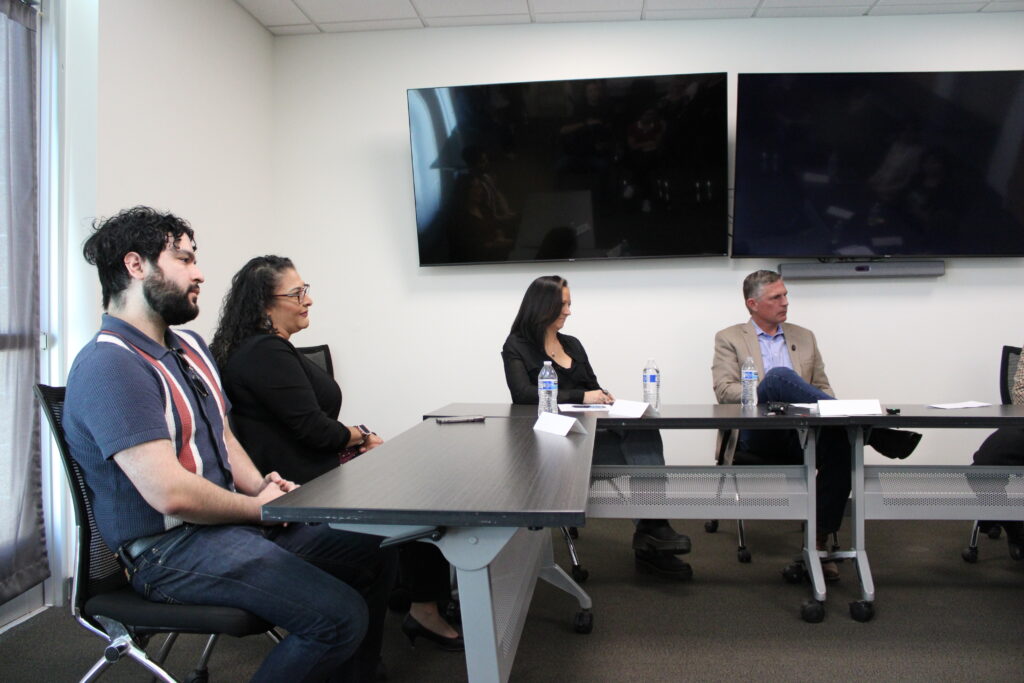
While the state’s senior U.S. senator is not shy about pointing fingers at President Donald Trump’s administration for creating these problems, he is also taking a leap of faith by opening negotiations with them on a key federal policy that he says could lower energy costs almost overnight.
In early March, Heinrich and Sen. Sheldon Whitehouse, a Democrat of Rhode Island and ranking member of the Senate’s Environment and Public Works Committee, quietly issued a joint statement announcing that they had agreed to open negotiations with the Trump administration over permitting reform.
That’s a simple label for a large portfolio of policies determining how long environmental reviews for new projects can drag on and dictating how quickly those projects can be built once they are funded by Congress and permitted by federal agencies. That includes more than $135 million in energy projects in New Mexico abruptly canceled by the U.S. Department of Energy in 2025, including a $15 million battery storage project for Kit Carson Electric CoOp in Taos and $35 million for local grid stabilizations to lower local energy bills. Those projects were among more than 200 projects already funded by Congress and permitted by the government that were canceled by the Trump administration across 21 states, in some cases mid-construction.
Had those projects been in place, Heinrich says, energy costs for New Mexicans could have been lower today.
“Once you start a war in the Middle East like this, there is no immediate actions that can get out of that tomorrow,” Heinrich told the group in Albuquerque. “But there are things like tariffs that they can take a different approach on. There are things like permitting. They could choose to move forward a whole lot of a whole lot of projects that are ready to be plugged into the grid tomorrow that would give people some relief.”
One possible vessel for permit reform, The SPEED Act, has already passed the House and is currently before Whitehouse’s committee but it needs work, including some assurances from the Trump administration, to earn Heinrich’s support.
“The SPEED Act is very limited in its scope,” Heinrich says. The bill sets timelines for completing environmental impact studies and permitting decisions, but it doesn’t go far enough for Heinrich who spent 17 years in both the House and Senate advocating for the $20 billion SunZia transmission project to move wind energy from New Mexico to energy-strapped communities in Arizona. It is estimated that it created 2,000 construction jobs and 100 permanent jobs for southern New Mexico.
“There is a real opportunity to do what I would call comprehensive permitting reform that that covers both the jurisdiction of my committee, which is Energy and Natural Resources but also the Environment and Public Works Committee, because that’s where all the clean water permitting and things land… [But] making sure we have robust transmission?.. The SPEED Act does not not get us all the way there. So that’s going to be really important if we’re going to maximize the kind of benefits on the kind of projects that we’ve seen in New Mexico.”
Nonetheless, Heinrich remains optimistic. “The Trump administration has met us sort of halfway. We’re willing to have this conversation, so that’s a real conversation. And something people could watch,” he says.
Share this story and start a conversation