

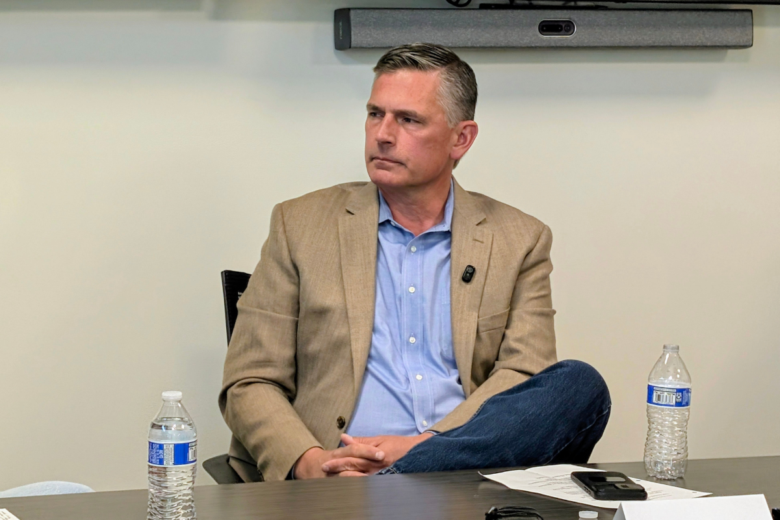
New Mexico families are spending hundreds — or thousands — of dollars more each year on gas, groceries and basic necessities, and U.S. Sen. Martin Heinrich heard directly from those feeling it hardest Thursday at an Albuquerque roundtable.
Heinrich gathered small business owners, food bank leaders, and workers at the Women’s Economic Self-Sufficiency Team (WESST) Albuquerque headquarters to discuss how federal tariff policy and rising energy costs are straining household budgets and threatening jobs across the state. “The administration right now is making policy choices that are showing up in our costs,” Heinrich said. “The tariffs that have been put in place — those are direct feeding costs to every small business.”
Chrystal Trykoski, co-owner of Enchanting Soap Collections, said her raw material costs have climbed sharply since 2023. The price of soap sampler boxes jumped from 49 cents to 75 cents, she said, and coconut oil costs have risen 126 percent. “We’re constantly trying to pivot and figure out how we can save — not only ourselves money, but we need our products to sell to keep these women employed,” Trykoski said. Her company employs women recovering from addiction and incarceration, and recently hired a survivor of human trafficking.
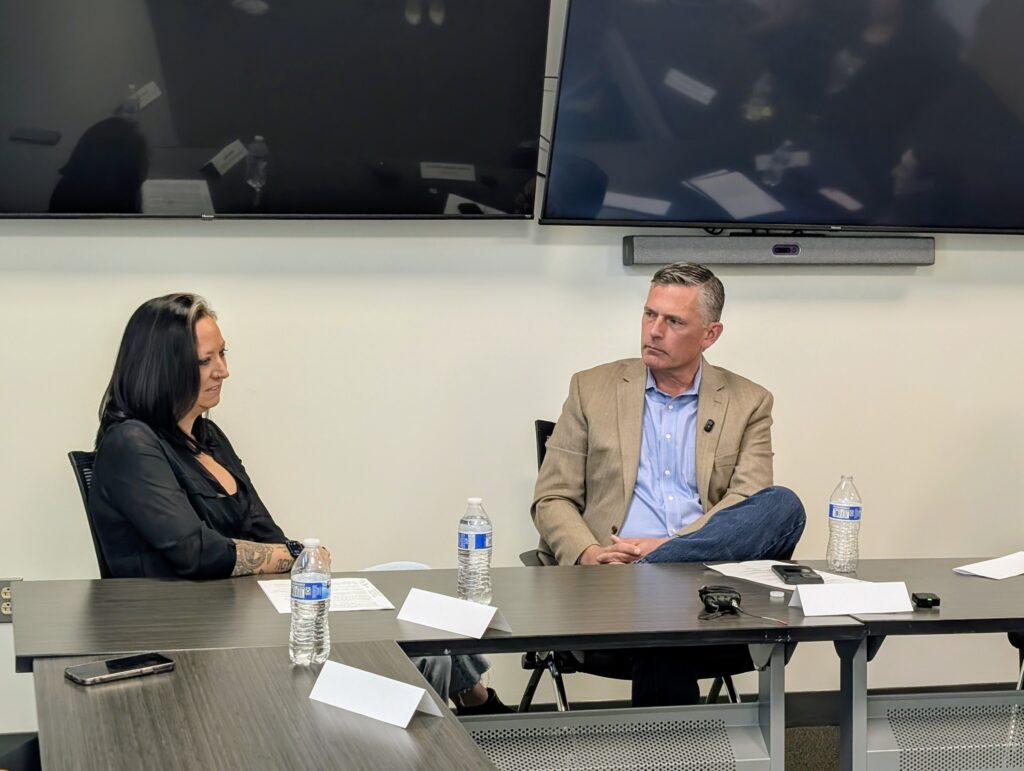
WESST President and CEO Lindsey Kay said the uncertainty is hitting small businesses statewide as hard as the cost increases themselves. “It’s hard to do your cost projections and know how to prepare if you don’t know what’s going to be happening with costs around supply chains,” Kay said. She added that rising costs are pushing more small business owners toward predatory lenders. “When you find that you’re in an environment where costs are increasing and there’s a ton of uncertainty, that creates a higher risk for folks to be more vulnerable to those types of tactics.”
Briana Smith of the South Valley Economic Development Center said a tariff bill held up the organization’s new $5 million produce aggregation facility by two months. “We received a tariff — almost a ransom of $47,000 — before they would release our equipment,” Smith said, describing processing machinery essential to connecting New Mexico farmers with consumers statewide. She said farmers are already scaling back. “We’re not going to have the same crops that we had in years past. Green chile takes a lot of water, a lot of fertilizer — that is a given.”
Film worker Giovanna Urbina, a member of IATSE Local 480, said New Mexico’s once-booming film industry has nearly gone dark. She said the union has close to 2,000 members statewide, but active union production has collapsed. “In 2024, we probably had 10 to 15 productions going at any given time,” she said. “Now there’s just been a huge drop.” Urbina, a single mother, said she faces losing her health insurance by the end of September without a new production job.
Heinrich said the pattern across every speaker reinforced his push to change federal policy. “Being able to hear these stories helps me push back against policies that just don’t make sense,” he said.
BY THE NUMBERS (according to Heinrich’s office, citing a U.S. Congress Joint Economic Committee report)
- $1,700+ — average annual cost of Trump’s tariffs to American families nationwide
- $1,355 — average annual cost to New Mexico families
- $45,087 — annual annual income a single adult needs to cover basic expenses in the Albuquerque metro area
- $60,718 — for a two-adult household
- $105,685 — for a family of four (Living expense figures from the Economic Policy Institute’s Family Budget Calculator, as cited by Heinrich’s office)
Make your voice heard:
- Contact Senator Heinrich: heinrich.senate.gov/contact
- Learn more about the Tariff Refunds for Working Families Act: heinrich.senate.gov
- Find small business support through WESST: wesst.org
- Find food assistance through Roadrunner Food Bank:rrfb.org